'/%3E%3C/svg%3E)


In short: why can heat strengthen the effect of oxygen therapy?
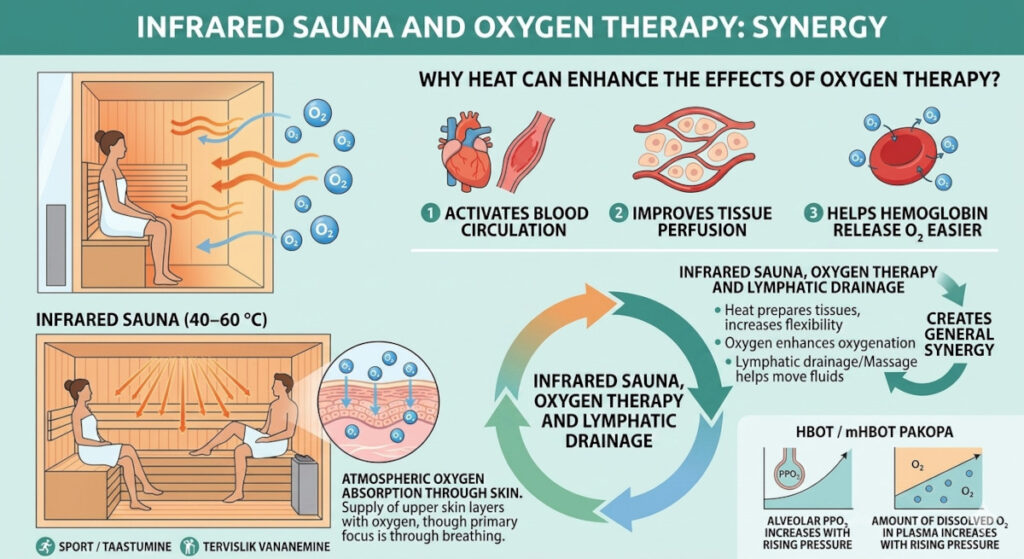
Gentle infrared sauna heat and supplemental oxygen work well together because heat activates circulation, helps tissues receive oxygen more efficiently, and creates more favorable conditions for oxygen release exactly where it is needed most. As the body warms evenly, blood vessels dilate, tissue perfusion improves, and hemoglobin releases oxygen more easily. [1][3][4]
This is why InfraSauna, oxygen therapy, and lymphatic drainage naturally complement one another: heat prepares the tissues, oxygen enhances oxygenation, and lymphatic drainage or massage helps move fluids and further strengthens the overall synergy of the treatments. [6][7]
The effect of heat on oxygen uptake conditions is one of the most interesting topics for people looking for more advanced wellness, recovery, and biohacking solutions. In practical terms, it means something very simple: properly selected heat can create more favorable conditions for circulation, oxygen delivery to tissues, and overall procedure tolerance, which is why infrared sauna with oxygen therapy is, for many people, a more logical and more comfortable combination than a very hot traditional sauna. [1][3][8]
Studies show that atmospheric oxygen can contribute meaningfully to oxygen supply in the upper layers of the skin, especially at the epidermal level. However, it is important to understand clearly that the body’s main oxygen supply occurs through the lungs and the bloodstream. For this reason, the strongest benefit of combining heat and oxygen therapy is associated not with “breathing through the pores,” but with improved circulation, better perfusion, and more effective oxygen release to tissues. [2][11]
Why does heat help oxygen work more effectively?
Does infrared sauna improve oxygen uptake?
Yes, but the temperature range matters. Gentle to moderate heat, usually around 40–60 °C, can improve circulation, increase tissue perfusion, and make it easier for oxygen to be released into tissues. In contrast, very high temperatures can create greater thermal stress and reduce overall treatment tolerance, so they do not always produce a better outcome. [1][3][8][9][10]
When the body is warmed moderately, several important processes happen at the same time. First, heat dilates peripheral blood vessels and increases circulation. Second, higher temperature reduces hemoglobin’s affinity for oxygen, so the blood releases oxygen to tissues more easily. Third, as body temperature rises, metabolic activity also increases, so tissues naturally begin to demand more oxygen. [1][3][4]
In clinical physiology, it is often emphasized that even a 1 °C increase in body temperature can require about a 10–12.5% increase in metabolic rate. This means that properly selected heat does not just relax the body, but also increases tissue oxygen demand and creates more favorable conditions for oxygen utilization. [4]
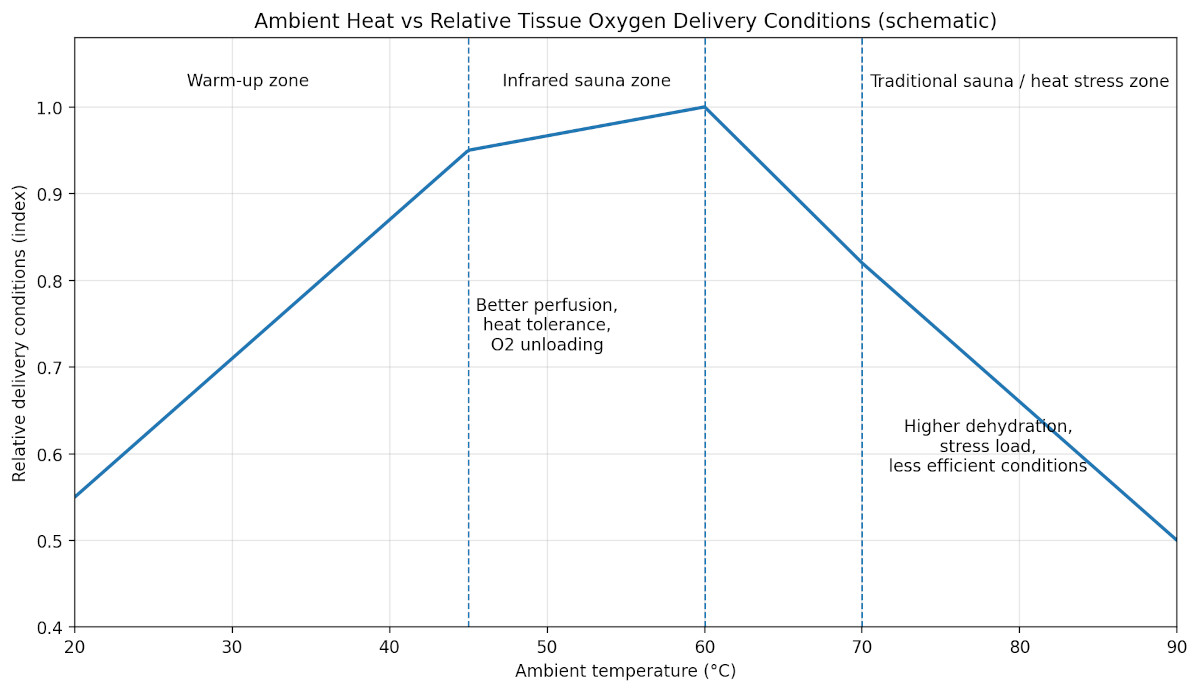
This diagram illustrates how, as temperature rises into the gentle to moderate heat zone, around 40–60 °C, circulation, perfusion, and hemoglobin’s ability to release oxygen to tissues improve. At very high temperatures, above roughly 70–80 °C, these benefits begin to be limited by thermal stress, dehydration, and lower treatment tolerance.
This diagram is illustrative and based on physiological principles rather than direct clinical measurement.
[3][8][9][10]
Why is infrared sauna better suited to this synergy than a traditional hot sauna?
Infrared saunas usually operate in a lower temperature range than traditional saunas. According to systematic reviews, infrared sauna interventions are most often applied in the 40–60 °C range, while classical Finnish saunas typically reach around 80–90 °C. This difference matters in practice: infrared sauna heat is generally easier to tolerate, easier to stay in for longer and more evenly, so more of the treatment value comes from physiologically useful processes rather than simply coping with overheating. [3]
Very high temperature does not necessarily mean greater benefit for oxygen therapy. Studies show that hyperthermia can reduce VO₂max and physical performance, while hotter traditional sauna protocols have been associated with a stronger sympathetic and hormonal stress response — increased catecholamines, ACTH, and a later rise in cortisol. This is why the 45–60 °C infrared sauna range is more rational for people looking not for extreme heat, but for a balanced combination of heat and oxygen. [8][9][10]
Would you like to make the most of the synergy between heat and oxygen therapy?
Rectangular infrared saunas – more space and comfort
95% oxygen: why is this an important parameter?
When discussing oxygen therapy, not only the concept itself matters, but also the technical parameters. 95% oxygen is a strong figure in the concentrator category because this type of equipment is typically described as delivering about 90–95% purity oxygen. In other words, 95% is at the upper end of the usual concentrator range. [5]
When this is combined with a flow rate of up to 10 l/min, the user receives not just a pleasant procedure, but a genuinely powerful oxygen delivery system. This is especially relevant for those looking for reliable home equipment, regular use, or a higher-level wellness setup. [5]
Looking for a complete solution for home or business?
Oxygen concentrators and O2 therapy equipment
Treatments in the center – infrared sauna + oxygen + lymphatic drainage
How does this synergy fit with lymphatic drainage and massage?
Gentle heat is valuable not only because of oxygen. Reviews of lymphatic vessel physiology show that temperature can affect lymph flow and the contraction dynamics of lymphatic vessels. In practice, this helps explain why gentle infrared sauna heat before lymphatic drainage or massage is often experienced as beneficial: tissues become softer, better prepared for the procedure, and fluid movement may become more active. [7]
This is also supported by research on the effect of heat on tissue elasticity. Heating can increase soft tissue flexibility and reduce the force required for movement or mobilization. This is why infrared sauna before lymphatic drainage, massage, or other mechanical treatment is logical not only from a comfort perspective, but also from a physiological one. [6]
This is exactly why infrared sauna + oxygen therapy + lymphatic drainage is not a random combination. Heat prepares the tissues, supplemental oxygen enhances oxygenation, and lymphatic drainage helps move fluids and complements the overall recovery logic. It is convenient, saves time, and allows several complementary mechanisms to be combined in a single treatment sequence. [6][7]
What changes when pressure is added: briefly about mHBOT and HBOT
This page focuses primarily on the effect of heat on oxygen uptake conditions in a normal 1 ATA environment. However, it is worth briefly mentioning the next step: when increased pressure is added to high oxygen concentration, alveolar oxygen pressure rises, and according to Henry’s law the amount of oxygen dissolved in blood plasma also increases. This is the core logic behind mHBOT and HBOT. [1][11]
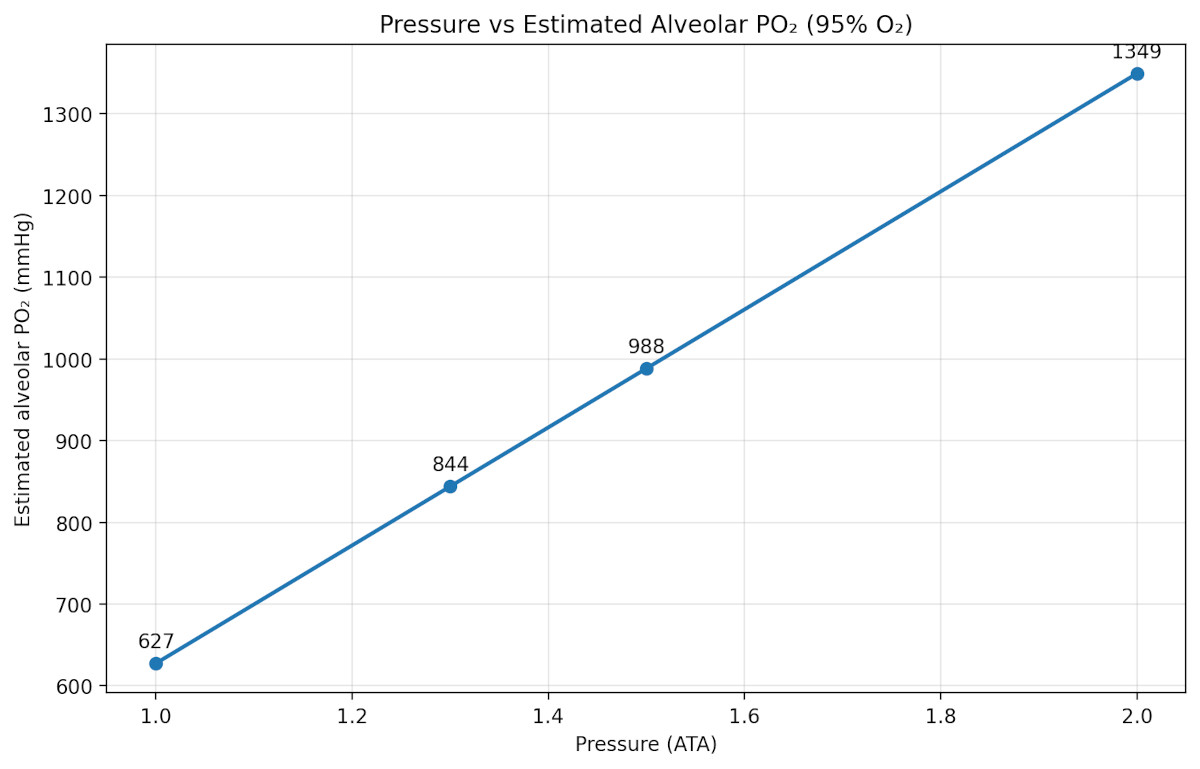
As pressure rises, alveolar oxygen pressure increases. This helps explain why mHBOT and HBOT are the natural next level of oxygen therapy.
This graph is illustrative and based on physiological logic.
[1][11]
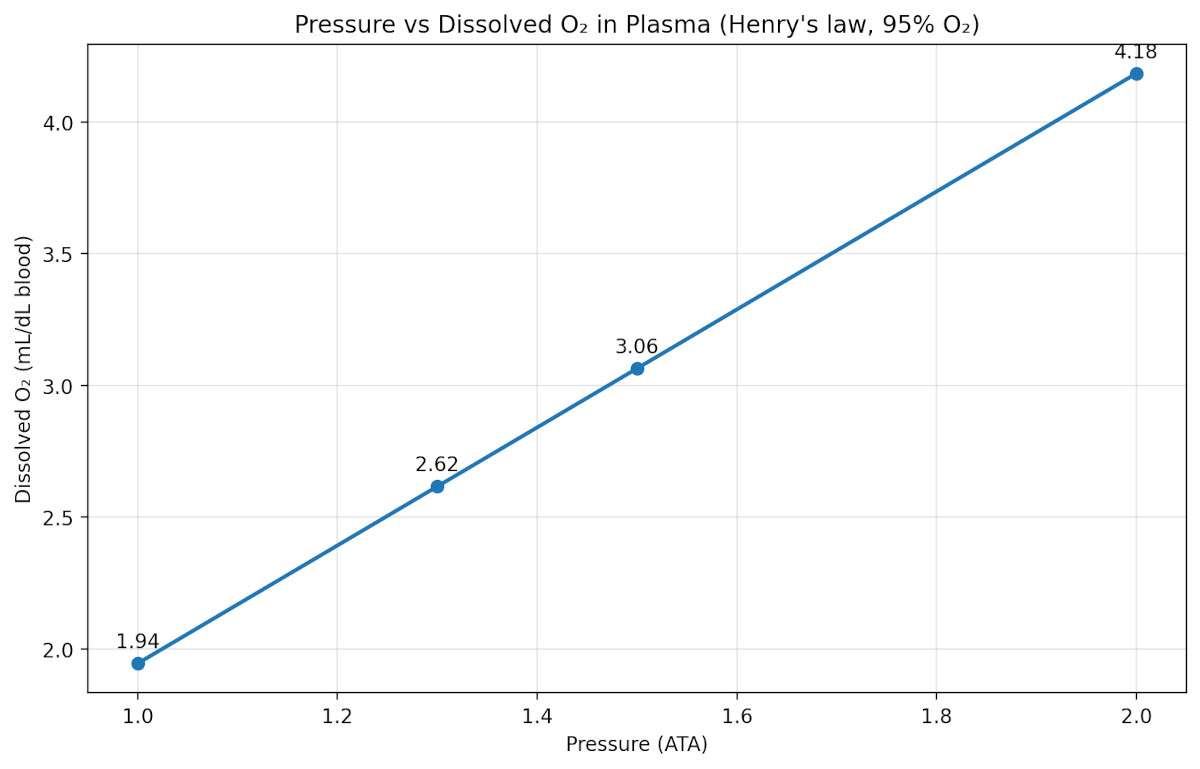
As pressure rises, the amount of oxygen dissolved in blood plasma increases significantly. This is one of the most important physiological differences between HBOT / mHBOT and normobaric oxygen therapy.
This graph is illustrative and based on the logic of Henry’s law.
[1][11]
You can read more about this in a separate article:
Hyperbaric chamber, hyperbaric chambers and HBOT.
Frequently asked questions
Does infrared sauna improve oxygen uptake?
Gentle infrared sauna heat can improve circulation, increase tissue perfusion, and help hemoglobin release oxygen to tissues more easily. This creates more favorable conditions for oxygen therapy than a neutral-temperature environment. [1][3][4]
What temperature is best when combining infrared sauna and oxygen therapy?
In most cases, the optimal range is around 40–60 °C. In this zone, circulation and oxygen release to tissues improve, while excessive thermal stress associated with very high temperatures is avoided. [3][8][9][10]
Can infrared sauna with oxygen therapy be used daily?
For many people, infrared sauna and normobaric oxygen therapy can be used regularly, but the frequency should be adjusted individually based on wellbeing, health status, and tolerance.
Is 95% oxygen a meaningful parameter?
Yes. In the concentrator category, this is a high figure because such devices are usually described as delivering about 90–95% purity oxygen. That makes 95% a strong technical argument for quality oxygen therapy. [5]
Can the skin absorb oxygen?
Yes, the skin can absorb some atmospheric oxygen, especially in the upper layers. However, the body’s main oxygen supply takes place through the lungs and the bloodstream. [2][11]
How does infrared sauna work together with lymphatic drainage?
Gentle heat helps prepare tissues, may engage lymph flow regulation mechanisms more actively, and can increase tissue flexibility. For this reason, lymphatic drainage or massage after heat is often experienced as more comfortable and more logical physiologically. [6][7]
Are HBOT and normobaric oxygen therapy the same?
No. Normobaric oxygen therapy takes place at normal atmospheric pressure, while HBOT or mHBOT use additional pressure. As pressure rises, the amount of oxygen dissolved in plasma also increases. [1][11]
Why combine infrared sauna, oxygen, and lymphatic drainage?
Heat prepares tissues and improves circulation, oxygen enhances tissue oxygenation, and lymphatic drainage helps move fluids. As a result, these treatments complement each other and may improve the overall recovery effect. [6][7]
Summary
If you are looking not for extreme heat, but for a smartly combined heat and oxygen therapy solution, infrared sauna is especially well suited. It heats more gently than a traditional sauna, helps circulation, improves the conditions for oxygen release to tissues, and naturally works well with lymphatic drainage, massage, and other recovery treatments. And when high-concentration oxygen is added, this synergy becomes even stronger — both in terms of wellbeing and practical treatment effectiveness. [1][3][5][6][7]
Sources
- https://www.ncbi.nlm.nih.gov/books/NBK499818/
- https://pmc.ncbi.nlm.nih.gov/articles/PMC2290093/
- https://pmc.ncbi.nlm.nih.gov/articles/PMC5941775/
- https://www.ncbi.nlm.nih.gov/books/NBK562334/
- https://my.clevelandclinic.org/health/treatments/25183-oxygen-concentrators
- https://pmc.ncbi.nlm.nih.gov/articles/PMC3747018/
- https://pmc.ncbi.nlm.nih.gov/articles/PMC7763507/
- https://pubmed.ncbi.nlm.nih.gov/15150660/
- https://pubmed.ncbi.nlm.nih.gov/8010136/
- https://pubmed.ncbi.nlm.nih.gov/616216/
- https://www.ncbi.nlm.nih.gov/books/NBK539815/