'/%3E%3C/svg%3E)


In short: what is a hyperbaric chamber and what is it useful for?
A hyperbaric chamber is a chamber in which a person breathes oxygen in a pressurized environment. This increases the partial pressure of oxygen, allows more oxygen to dissolve in blood plasma, and delivers a greater “dose” of oxygen to tissues. [1][2]
In practice, this means better tissue oxygenation, more favorable conditions for recovery and regeneration, and a practical option for consistent use at home or in a center, especially when therapy is applied as a course rather than a single procedure. [7][15][16]
A hyperbaric chamber, also called a hyperbaric oxygen chamber, is a solution that allows a person to breathe higher-concentration oxygen in a pressurized environment. Such hyperbaric oxygen therapy (HBOT) or mHBOT helps significantly increase oxygen delivery to tissues and supports the body’s natural recovery processes. [1][2]
Our range includes 1.3 ATA soft-shell double chambers, 1.5 ATA soft-shell HBOT chambers, and 2.0 ATA hard-shell hyperbaric chambers, used together with 95% oxygen concentrators up to 10 l/min. This is a practical choice for people looking for home oxygen therapy, the possibility of regular use, or the option to visit an oxygen therapy center. [3][4][5]
Interested in oxygen therapy equipment or procedures?
What is a hyperbaric chamber and how does hyperbaric oxygen therapy work?
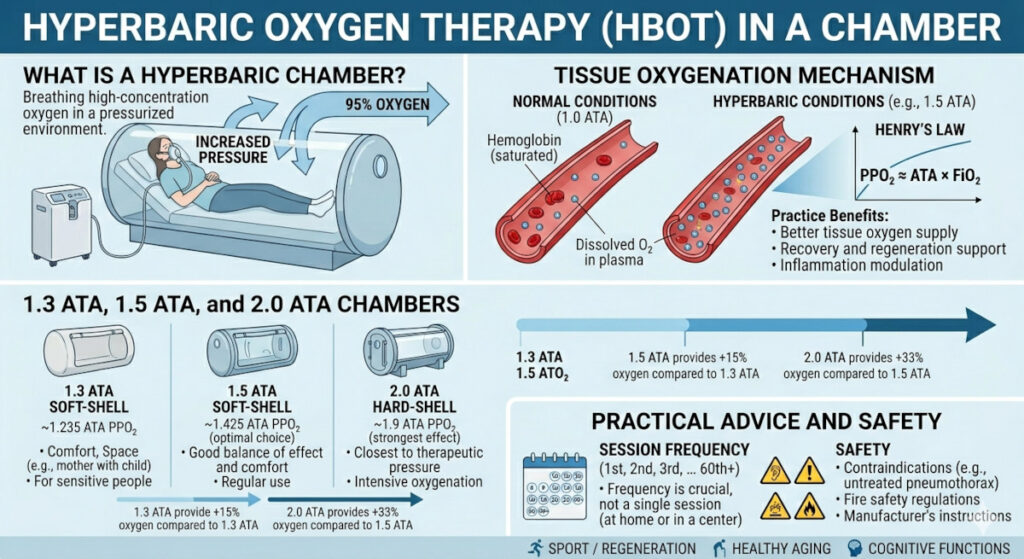
A hyperbaric chamber is a pressurized chamber in which a person breathes oxygen in a pressurized environment. The basic logic is simple: the higher the partial pressure of oxygen, the more oxygen can dissolve in blood plasma and reach tissues. For this reason, HBOT therapy and mild hyperbaric oxygen therapy (mHBOT) are often associated with improved tissue oxygenation, recovery, and support for regenerative processes. [1][2]
Why are pressure and oxygen concentration so important?
The effect of oxygen is determined not only by its percentage but by its partial pressure of oxygen (PPO₂) – the actual “oxygen dose” received by the body. In simplified form, this can be expressed by the formula:
PPO₂ ≈ ATA × FiO₂
When approximately 95% oxygen is used, the comparison looks like this:
- 1.0 ATA × 0.21 ≈ 0.21 ATA – normal ambient air;
- 1.3 ATA × 0.95 ≈ 1.235 ATA;
- 1.5 ATA × 0.95 ≈ 1.425 ATA;
- 2.0 ATA × 0.95 ≈ 1.9 ATA.
This shows that even a 1.3 ATA hyperbaric chamber differs significantly from the normal environment, a 1.5 ATA hyperbaric chamber provides even greater oxygen exposure, and a 2.0 ATA HBOT chamber approaches therapeutic pressures used in classical hyperbaric practice. Real alveolar and arterial pO₂ are additionally influenced by water vapor and CO₂, so this is an approximate but very useful comparison. [1]
Quick comparison of 1.3 ATA, 1.5 ATA, and 2.0 ATA
1.3 ATA – more comfortable and spacious, especially suitable for more sensitive users, a mother with a child, or procedures performed together.
1.5 ATA – usually the most optimal choice for most people, offering a very good balance between effect, comfort, and practical regular use.
2.0 ATA – the strongest of the offered modes, closest to therapeutic pressures, and relevant for those looking for a more intensive oxygenation effect. [1][17]
Tissue oxygenation mechanism
According to Henry’s law, as the partial pressure of oxygen increases, the amount of oxygen dissolved in blood plasma also increases. Under normal conditions, only about 0.3 ml O₂/dl is dissolved in plasma, but under hyperbaric conditions this amount can increase several-fold or even more, depending on the pressure and protocol. This additional oxygen dissolved in plasma is one of the key advantages of HBOT and mHBOT. [2][6]
Hemoglobin saturation and the additional benefit of HBOT
Under normal conditions, hemoglobin is often already saturated to about 97–100%, so the value of hyperbaric oxygen therapy is not simply “more oxygen in hemoglobin.” The key benefit is that in a hyperbaric environment the amount of oxygen dissolved in plasma increases, which can more easily reach areas where tissues have poorer blood supply, inflammation, trauma, or hypoxia. [2][11]
What does this mean in practice?
- better tissue oxygen supply;
- more favorable conditions for recovery and regeneration;
- support for angiogenesis and collagen synthesis;
- modulation of inflammatory processes;
- a more favorable environment for certain healing processes.
For this reason, oxygen therapy in a hyperbaric chamber is usually associated not with one isolated effect, but with a combination of several physiological mechanisms. [7][8]
Comparison of 1.3 ATA, 1.5 ATA, and 2.0 ATA hyperbaric chambers
| Chamber | Approximate oxygen “dose” | Best suited for |
|---|---|---|
| 1.3 ATA double soft-shell | ~1.235 ATA at ~95% O₂ | Comfort, more sensitive users, mother with child, procedures done together, and those who value more space. |
| 1.5 ATA soft-shell | ~1.425 ATA at ~95% O₂ | The most universal choice – a very good balance between effect, comfort, and practicality. |
| 2.0 ATA hard-shell | ~1.9 ATA at ~95% O₂ | For those looking for the strongest mode offered and a solution closer to therapeutic pressure. |
Compared with each other, 1.5 ATA provides about a 15% greater approximate oxygen exposure than 1.3 ATA, while 2.0 ATA provides about a 33% greater exposure than 1.5 ATA. This clearly shows that 1.3 ATA is not a “weak” option, 1.5 ATA is a very strong everyday-use compromise, and 2.0 ATA is a more intensive step up. [1]
What does the literature show about arterial pO₂ and dissolved oxygen?
Classical reviews indicate that breathing 100% oxygen at 1.5 ATA can result in arterial pO₂ of about 1053 mmHg, while dissolved oxygen in plasma can reach about 3.26 vol%. At 2.0 ATA, arterial pO₂ values rise even higher, and the amount of oxygen dissolved in plasma can theoretically reach about 4.4 ml/dl or more, depending on the protocol and calculation model. This is one of the main physiological arguments showing why higher pressure means a stronger oxygenation effect. [6][9][10]
What benefits can be communicated responsibly?
HBOT / mHBOT chambers are most often associated with the following areas:
- recovery and regeneration after physical or functional exertion;
- improved tissue oxygenation;
- modulation of inflammatory processes;
- support for healing processes;
- cognitive function and “brain fog” – as an area under investigation;
- healthy aging and cellular marker changes – as a promising research area;
- sports recovery and support for oxygen availability.
The most accurate way to communicate this is not as a “universal cure,” but as a physiologically grounded method that may help improve tissue oxygenation and support the body’s recovery processes. [7][12][13][14]
How many procedures are usually needed?
In practice, hyperbaric oxygen therapy is most often viewed as a course-based method, not a one-time procedure. Studies commonly use protocols of 10–40 sessions or longer, applied several times per week. [15][16]
For this reason, what matters most to the client is not just “trying it once,” but choosing a solution that can realistically be used regularly: at home, at one’s own pace, or in an easily accessible center.
Why is one session usually not enough?
One of the most important practical aspects is that the effect of a hyperbaric chamber is usually associated with course-based use, not with a single visit. Many studies use 10–40 sessions or even longer protocols, usually performed several times per week. This means that regularity is a very important part of the total “oxygen dose.” [15][16]
In practice, this is especially important for people living farther away from cities or specialized centers. When a hyperbaric oxygenation course requires many sessions, owning a chamber at home or having access to a nearby center may be a much more convenient and economically reasonable solution than rare, long, and costly trips to a distant facility.
Typical usage pattern
- initial stage – becoming familiar with the procedure and adapting to it;
- active course – several sessions per week, often in cycles of 10–40 procedures;
- maintenance mode – less frequent use after a more intensive course.
Why are lower pressures more practical for many people?
1.3–2.0 ATA hyperbaric chambers allow significant tissue oxygenation at lower pressures, which for many users are more practical, more comfortable, and easier to integrate into regular use. In contrast, higher pressures above 2.0 ATA, more often used in medical HBOT practice, usually require stricter protocols, closer health evaluation, and qualified supervision. [17][18]
In communication, this is best emphasized like this: for many clients, a more practical path is not a one-time very high-pressure procedure, but a consistent course at lower pressure, which can be repeated safely and conveniently. This does not mean that high-pressure medical HBOT is unnecessary – it is important for certain clinical indications. However, in terms of everyday use, wellbeing, recovery, and accessibility, 1.3, 1.5, and 2.0 ATA solutions are much more practical for many people.
Safety: what is important to know before using a hyperbaric chamber?
Even lower-pressure oxygen chambers must be used responsibly. An absolute contraindication to hyperbaric therapy is an untreated pneumothorax, and there are other conditions and risk factors that must be assessed before starting a course. [18]
The most commonly described adverse effects include ear or sinus barotrauma, temporary visual changes, and a sensation of pressure. Oxygen toxicity seizures are rare, but the risk increases with rising pressure and exposure intensity, so higher-pressure modes should not be treated lightly. [19]
In high-oxygen environments, it is also essential to strictly follow fire safety rules and the manufacturer’s instructions. Regulators specifically emphasize fire risk, so safety must always remain a priority. [20][21]
Choose the oxygen therapy solution that suits you best
Looking for equipment for home or business?
Oxygen therapy equipment and tools
Would you like to try procedures in a center first?
Frequently asked questions about hyperbaric chambers and HBOT
What is a hyperbaric chamber?
A hyperbaric chamber is a pressurized chamber in which a person breathes oxygen in a pressurized environment in order to improve tissue oxygen supply.
What is the difference between 1.3 ATA, 1.5 ATA, and 2.0 ATA chambers?
The difference is in pressure and the resulting oxygen exposure. 1.3 ATA is milder and more comfortable, 1.5 ATA is usually considered the most universal option, and 2.0 ATA provides the strongest effect among the offered solutions.
Are 95% oxygen and 10 l/min significant?
Yes. High-purity oxygen and sufficient flow are important for achieving a high inspired oxygen fraction and more stable oxygen therapy quality. [3][5]
Is one procedure enough?
Usually not. In practice, the most important factor is the course and the regularity of procedures. One session may serve as an introduction, but greater changes are more often associated with consistent use. [15][16]
Is a hyperbaric chamber suitable for home use?
For many people, yes – especially when the priority is regularity, convenience, and the ability to perform procedures at one’s own pace. However, contraindications must be assessed before use and all manufacturer safety requirements must be followed. [18]
Summary
If you are looking for a solution that is both physiologically grounded and practically usable, a hyperbaric chamber with a 95% oxygen concentrator can be a very rational choice. 1.3 ATA is suitable for those who value comfort and space, 1.5 ATA is the most optimal option for many people, and 2.0 ATA is the strongest of the offered modes and the closest to therapeutic pressures.
The most important thing is not simply “which pressure is the highest,” but which solution will actually be used regularly, safely, and consistently.
Sources
- https://www.ncbi.nlm.nih.gov/books/NBK482268/
- https://www.ncbi.nlm.nih.gov/books/NBK538336/
- https://my.clevelandclinic.org/health/treatments/25183-oxygen-concentrators
- https://pmc.ncbi.nlm.nih.gov/articles/PMC6876135/
- https://iris.who.int/bitstreams/6a4ae877-d02b-4db5-80d2-751090650f69/download
- https://stairs.se/wp-content/uploads/2017/09/the-medical-use-of-oxygen-a-time-for-critical-reappraisal.pdf
- https://pmc.ncbi.nlm.nih.gov/articles/PMC4175035/
- https://www.ncbi.nlm.nih.gov/sites/books/NBK482485/
- https://www.mdpi.com/1648-9144/57/1/49
- https://www.openaccessjournals.com/articles/hyperbaric-oxygen-therapy-in-the-management-of-nonhealing-wounds-in-patients-with-critical-limb-ischemia.pdf
- https://pmc.ncbi.nlm.nih.gov/articles/PMC10717139/
- https://pmc.ncbi.nlm.nih.gov/articles/PMC12101694/
- https://pmc.ncbi.nlm.nih.gov/articles/PMC8888529/
- https://pmc.ncbi.nlm.nih.gov/articles/PMC7746357/
- https://clinicaltrials.gov/study/NCT04647656
- https://bmjopen.bmj.com/content/15/4/e094386
- https://www.uhms.org/resources/featured-resources/hbo-indications.html
- https://www.ncbi.nlm.nih.gov/books/NBK557661/
- https://www.ncbi.nlm.nih.gov/sites/books/NBK459191/
- https://www.fda.gov/medical-devices/letters-health-care-providers/follow-instructions-safe-use-hyperbaric-oxygen-therapy-devices-letter-health-care-providers
- https://recalls-rappels.canada.ca/en/alert-recall/unlicensed-soft-shelled-hyperbaric-chambers-may-pose-serious-health-risks
You can find more information in this article: Report on infrared saunas and oxygen therapy